Key Takeaways
- Indian supermarket checkouts in 2026 need to handle GST across mixed-rate baskets, UPI as the default payment method, and split payments, all without slowing down the line.
- Billing software that treats these as separate add-ons, rather than one connected checkout flow, creates friction exactly where speed matters most.
- GST accuracy at a supermarket counter depends on rate mapping at the SKU level, not manual entry during a rush.
- UPI has become the primary payment method at most Indian retail counters, which means billing software needs to treat it as a core flow, not a secondary option next to cash.
- Supermarket billing software in 2026 needs to be judged on how well it handles all three together, not any one of them in isolation.
A supermarket checkout in India today looks nothing like it did a few years ago. A single basket might mix zero-rated staples with higher-GST packaged goods, get paid for partly in UPI and partly in cash, and need a GST-compliant invoice printed in under a minute, all while a queue is forming behind it. Billing software that handles each of these well individually, but not together, still creates a slow, error-prone counter. This blog looks at what supermarket billing software actually needs to get right on GST, UPI, and split payments in 2026, and why treating them as one connected flow matters more than treating them as separate features.
Why These Three Can’t Be Handled in Isolation
It’s tempting to evaluate billing software feature by feature: does it support GST, yes; does it support UPI, yes; does it support split payments, yes. But a supermarket counter doesn’t process these one at a time. A single transaction routinely needs all three at once, a mixed-rate basket, paid partly by UPI and partly by cash, with a GST-compliant invoice generated instantly. If the software handles each feature well individually but doesn’t connect them cleanly, the friction shows up exactly at checkout, the one place a supermarket can least afford it.
What GST-Ready Billing Needs to Handle in a Supermarket
Supermarket baskets are rarely single-rate. A shopping trip might include zero-rated staples, standard-rate packaged food, and higher-rate personal care or FMCG items, all billed in one transaction. Getting this right depends on the same principle covered for pharmacy billing in why every pharmacy needs GST-compliant billing software: GST rates mapped to each SKU’s HSN code automatically, applied at billing, not left to manual entry under pressure.
- GST rate and HSN code mapped per SKU, not chosen manually at the counter
- Mixed-rate baskets billed correctly in a single invoice, without manual splitting
- GST reports generated in a format ready for filing, not raw data needing cleanup
- Return and refund flows that adjust GST correctly, not just the item total
What UPI-Ready Billing Needs to Handle at Scale
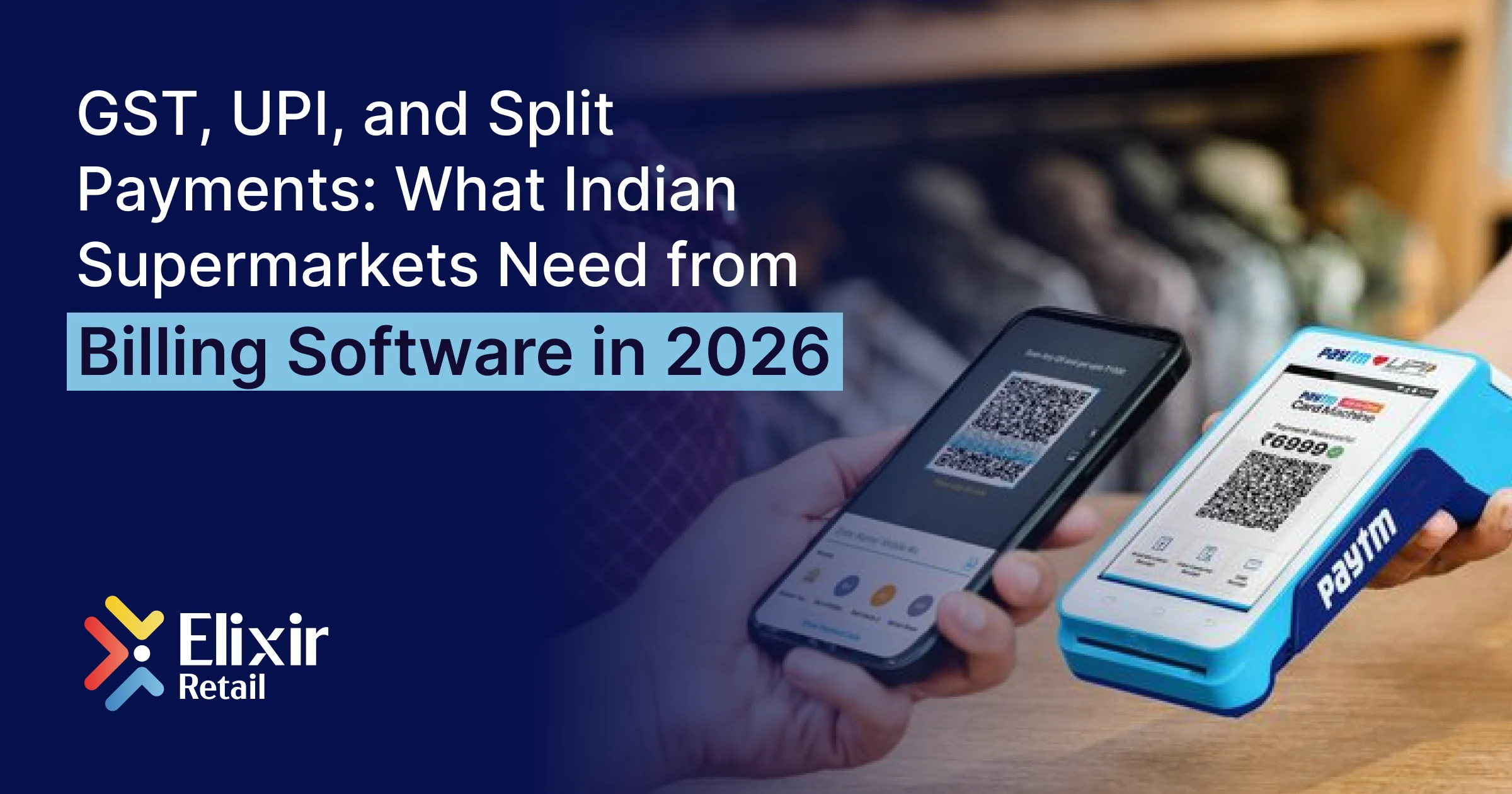
UPI isn’t a secondary payment option at most Indian supermarket counters anymore, it’s often the default. Billing software built for 2026 needs to treat it as a first-class flow rather than something bolted onto a cash-first system.
- UPI accepted as a primary flow, not routed through a workaround
- Payment confirmation fast enough that it doesn’t become the bottleneck in the checkout line
- UPI transactions reconciled automatically against daily sales, not manually matched later
- Failed or pending UPI payments handled with a clear retry path, not a stalled counter
What Split Payment Support Actually Needs to Look Like
Customers increasingly split a single bill across UPI, cash, cards, or store credit, sometimes across more than two methods in one transaction. Billing software needs to handle this without turning it into a manual workaround.
- Multiple payment methods applied to a single invoice without separate transactions
- Split amounts tracked accurately against the total, with no manual reconciliation needed
- Each payment method’s share reflected correctly in daily settlement and reporting
- Partial payments and store credit handled within the same flow, not outside the system
Checklist: Is Your Supermarket Billing Software 2026-Ready?
- GST rates mapped automatically at the SKU level, not chosen manually at billing
- Mixed-rate baskets billed correctly in one invoice, every time
- UPI treated as a default payment flow, with fast confirmation
- UPI transactions reconciled automatically against sales data
- Split payments across multiple methods handled within a single transaction
- Daily settlement reporting reflects UPI, cash, card, and split totals accurately
- GST reports generated ready for filing, not needing manual correction first
Why This Matters Beyond the Counter
None of this is just a checkout convenience. GST errors compound into filing headaches, the same issue covered in the pharmacy GST context, where a mismatched invoice today becomes a reconciliation problem weeks later. Payment friction at the counter slows down the exact moment a supermarket is trying to move customers through fastest, especially relevant for stores that have already invested in digitising their billing setup. And clean, connected payment and GST data feeds directly into margin visibility, tying back to the broader point made in retail pricing strategy, where knowing your real numbers starts with the data being accurate at the point of sale.
How Elixir Retail 360 Supports GST, UPI, and Split Payments
Elixir Retail’s supermarket billing software applies GST rates automatically at the SKU level, so mixed-rate baskets are billed correctly without manual intervention. It supports UPI as a core payment flow alongside cash, cards, and split payments across multiple methods in a single transaction, with all of it reconciled automatically into daily settlement reports.
It pairs with Elixir Books for GST filing, so return preparation draws on data that’s already correct at the point of billing, rather than needing a separate cleanup step.
If your checkout is still treating GST, UPI, and split payments as separate workarounds instead of one connected flow, book a free demo and see what a 2026-ready counter actually looks like.
Frequently Asked Questions
Why do GST, UPI, and split payments need to work together in supermarket billing software?
Because a single supermarket transaction routinely involves all three at once, a mixed-rate basket, paid partly by UPI, with a GST-compliant invoice required immediately. Software that handles each well separately but not as one connected flow creates friction exactly at checkout, where speed matters most.
How should supermarket billing software handle mixed-GST-rate baskets?
GST rates should be mapped to each SKU’s HSN code automatically and applied during billing, so a basket with staples, packaged food, and higher-rate items is billed correctly in a single invoice without manual rate selection.
Is UPI reconciliation different from card or cash reconciliation?
It needs to be automatic and near real-time given UPI’s volume at most counters. Billing software should match UPI transactions against daily sales automatically, rather than requiring manual matching against a bank statement later.
Can split payments across three or more methods be handled in one transaction?
Yes, with the right billing software. A single invoice should support amounts split across UPI, cash, card, and store credit together, with each method’s share reflected correctly in settlement reporting, not processed as separate transactions.
Does GST-ready billing software help with return filing too?
It should. Beyond generating correct invoices, it should produce GST reports already structured for filing, reducing the reconciliation work needed when return season comes around, similar to what’s expected from GST filing software built for Indian retail.
A supermarket counter in 2026 is judged by how well it handles GST, UPI, and split payments together, in the same transaction, without slowing the line down. Billing software that treats these as one connected checkout flow, rather than three separate features, is what actually keeps up with how Indian shoppers pay today.