


Retailers Should Focus on Customers, Not Cash or Competition
I have said this to every retailer I have consulted with over the past 25 years: advice that separates stores that grow from those that fail.
The game of growth is between you, the supplier and the customer. Focus on what matters – a great supplier strategy and a smarter retail pricing strategy that delivers genuine customer value.
What a Customer Walks in for: grocery store margin
Let’s take a scenario here. A customer will remember a brand like Adidas or Reebok for quality – that is their brand credibility.
But that same customer walks into a neighbourhood retail store, and they are not consumed by logos or elite brands. They walk in looking for:
- A better deal
- Lower prices
- Honest margins
- A discount that makes them feel it’s worth the purchase
In my honest opinion, any store that consistently offers better pricing – wins. You will see your customers come back and bring their neighbours too.
This isn’t a sophisticated pricing model – not algorithm-based, but transparency and trust-based.
Your store secures loyal customers that no advertising can provide. Customer loyalty is what a retailer should chase.

The Golden Rule Most Retailers Don’t Apply
Having worked closely with retailers across their businesses – their processes, software, and tools, there is one strategy that most of them leave behind.
The strategy is simpler than most people expect and harder than they admit.
Get your retail margin from your supplier, not from your customers.
Even a 1% saving in buying costs can improve retail profit a lot.
This is the principle that should echo through every retail business.
Fight with your supplier. Negotiate harder and push for better discounts on every product line. That’s where the margins come from. It is not raising prices on the customer standing at your counter who trusts your quality, but better negotiations with the supplier – this is what a strong procurement strategy looks like in practice.
Most retailers that fail in the long term are the ones that squeeze customers instead of securing better pricing from the supplier. It may not have shown initially in their numbers, but it showed up sooner when their customer shifted brand focus to another store, and most never understood why.
Supplier relationship management is the relationship you want to revisit often. Every season and every pricing detail needs to be thought of from the customer’s perspective.
Remember – build with the supplier, build with the customer, build with the market.
Most retailers, when they start to audit this, find suppliers they have been overpaying for years, simply because they didn’t negotiate or even have the time to look from a strategic point of view. That gap, once closed, will be the window to offer customers better pricing without touching your own margin.
My learning has been to watch this play out enough times to know it’s not a theory. It is the single biggest lever I have used to help retail store grow their sales and revenue.
The DMart Lesson Every Retailer Should Be Studying
Everyone relies on DMart. Why?
DMart is regarded as one of the most profitable business models in India. It has not only survived but also surpassed the scale expected of retail businesses in India. As of Mid-2026, there are 503 operational DMart stores in India. The 500-store milestone was built on value to customers, not just velocity.
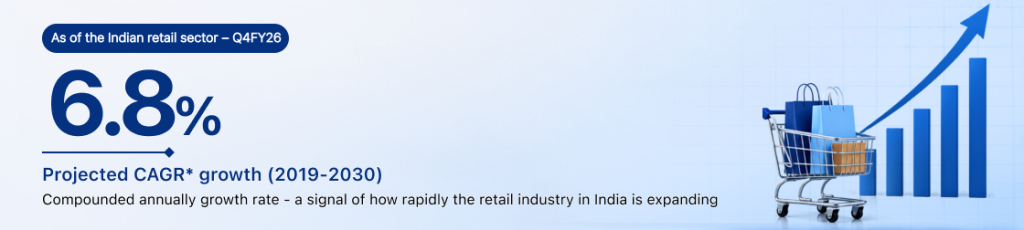
This is the retail empire every retailer can aspire to build in India, contributing to the country’s socio-economic development. According to The Economic Times – The retail sector contributes around 10 per cent to India’s GDP and supports nearly 50 million jobs.
Why is its business model worth studying?
DMart delivers good quality products at low prices, and the reason is supplier strategy. It negotiates aggressively on procurement, often buying in volume and committing early, so the savings pass right to the customer on the shelf.
No clever marketing required, just a strong supplier strategy.
No burden should land on the customer at the billing counter. Cultivate this mindset to adopt at your own scale.
I understand – a small grocery store can’t negotiate like DMart negotiates, but it can ask the same question DMart asks:
Where is the inefficiency in the supplier relationship? And who is consuming it – The store or the customer?
Why Better Prices Bring More Customers and How to Increase Sales in Retail
Here’s the moment that defines whether a retailer keeps their customers or loses them – and it has nothing to do with festivals, offers, or marketing campaigns.
It’s what you do when the market prices come down.
When supplier costs drop and product prices in the market fall – the test is simple: I ask you this – Do you pass the benefit to the customer, or do you keep the profits in your pocket when no one is watching?
Greed spoils retailers.
I have seen it firsthand. A store builds loyalty for years, then prices drop, and they don’t pass it on to customers, and trust begins to erode quietly. Customers notice. They start comparing prices with the shop nearby. The business dips.
The real cost of greed is never the lost margin on one transaction. It is the lost trust.
Why This Works Differently in a Neighbourhood
To all the aspiring retailers who are building from the ground up – these aren’t AI-powered interactions.
These are human connections built with neighbourhoods, with families, with other shopkeepers every day.
A walk down the lane becomes the basis of word-of-mouth marketing and trust, which will make them your loyal buyers for generations.
Our business invites customers through affordability, not greed. Anchored on quality and honest margins, sustained by a persuasive supplier strategy that exists for one purpose – to give our customers lower prices.
Backed by discipline, negotiation and a commitment to go long-term with stronger connections that add both value and revenue to the business.
The Night I Slept in My Car
I recall spending a night in my car outside a customer’s grocery store.
It was his first store, and he was nervous. I wanted to be there to see whether the supplier margins we had negotiated were reflected on the shelf. I watched the ground realities, advised in real time, and made sure the strategy we had built on paper was being executed.
Most retail shops at the time were 10 by 16 sq. ft.
Today, stores run out of 3,000 sq. ft., and I see the expansion writing India’s retail story.
That growth did not happen overnight. The same discipline was applied consistently:
- Get the margin from the supplier
- Pass the benefit to the customer
- Never let greed override honest pricing
Better prices brought more customers. More customers brought more revenue. More revenue funded the expansion.
Twenty-five years later, that discipline chain remains the same.
What 25 Years in the Retail Ecosystem Taught Me
No dashboard or report has taught me what walking the stores, connecting with retailers, overseeing their operations and checking on their supplier strategy has taught me.
My experience has been shaped in supplier meetings and in a car parked outside a nervous first-time store owner’s shop.
This kind of experience tells you where the real leak in a retailer’s retail margin is.
I practically studied every retail business I guided to know their challenges, and nothing has been more outcome-based than the supplier strategy and pricing discipline. It’s the philosophy behind all conversations I have had with retailers that has continued with ELIXIR Retail.
If you are a retailer wondering why your customers are drifting or why your margins feel tight despite what looks like competitive pricing – the answer is somewhere in your supplier relationship or your pricing decisions.
After 25 years in the retail ecosystem – This is where I would start with you.