Key Takeaways
- Supermarket POS software connects billing, inventory, purchasing, pricing and customer data in one system.
- Real-time stock, batch and expiry tracking help reduce shrinkage, stockouts and avoidable write-offs.
- Permission controls and audit trails make discounts, returns and cancellations easier to monitor.
- The right system should support GST billing, multiple counters, multiple stores and automated purchasing.
Walk into many Indian supermarkets today and the same gaps appear: manual billing errors, shelf prices that do not match the register, expired stock in the storeroom and popular products running out at the worst time. These are not simply staffing problems. They are system problems.
According to IndexBox’s 2026 market analysis, India’s food and grocery retail market is valued at roughly USD 740–780 billion. Organised retail—including supermarkets, hypermarkets, modern convenience formats and ecommerce—accounts for approximately 18–22% of the market, up from about 12% in 2019.
Growth, however, does not guarantee profit. Stores with strong footfall and full shelves can still lose margin through gaps that remain unnoticed for months. The businesses pulling ahead are not necessarily the biggest. They are often the ones running the tightest operations, powered by the right supermarket POS software behind the billing counter.
Where Supermarket Profits Actually Go Missing
Every supermarket owner knows the feeling of a strong sales day that somehow does not translate into strong month-end numbers. The reason is rarely one dramatic event. It is usually the cumulative effect of many small leaks.
Shrinkage That Hides in Plain Sight
Retailers lose substantial sums to shrinkage each year. The Appriss Retail 2026 Total Retail Loss Benchmark estimates USD 90 billion in annual shrink in the United States, with 73% attributed to preventable causes. For a supermarket, shrinkage can appear as expired stock, inventory errors, billing mismatches, unauthorised discounts or simple counting mistakes. The important lesson is universal: stores need to catch gaps at the point of sale, not months later during an annual audit.
Stockouts on Best-Sellers and Overstock on Slow Movers
Without real-time visibility into sales velocity, supermarkets often over-order slow-moving items and under-order fast-moving ones. A popular product runs out during peak hours while shelves of a slow SKU continue tying up working capital.
Manual Processes Consuming Staff Hours
Handwritten purchase orders, manual stock counts and end-of-day reconciliation consume hours without improving the customer experience. Those hours could instead be spent on service, merchandising and sales.
Pricing Chaos Across Thousands of SKUs
A supermarket without centralised price control is one shelf-tag error away from a customer dispute, a compliance problem or a quiet loss on every sale of an incorrectly priced item.
Individually, these problems look like minor operational hiccups. Together, they explain how a supermarket can post healthy revenue and still struggle to produce healthy profit.
What a Supermarket POS System Actually Does
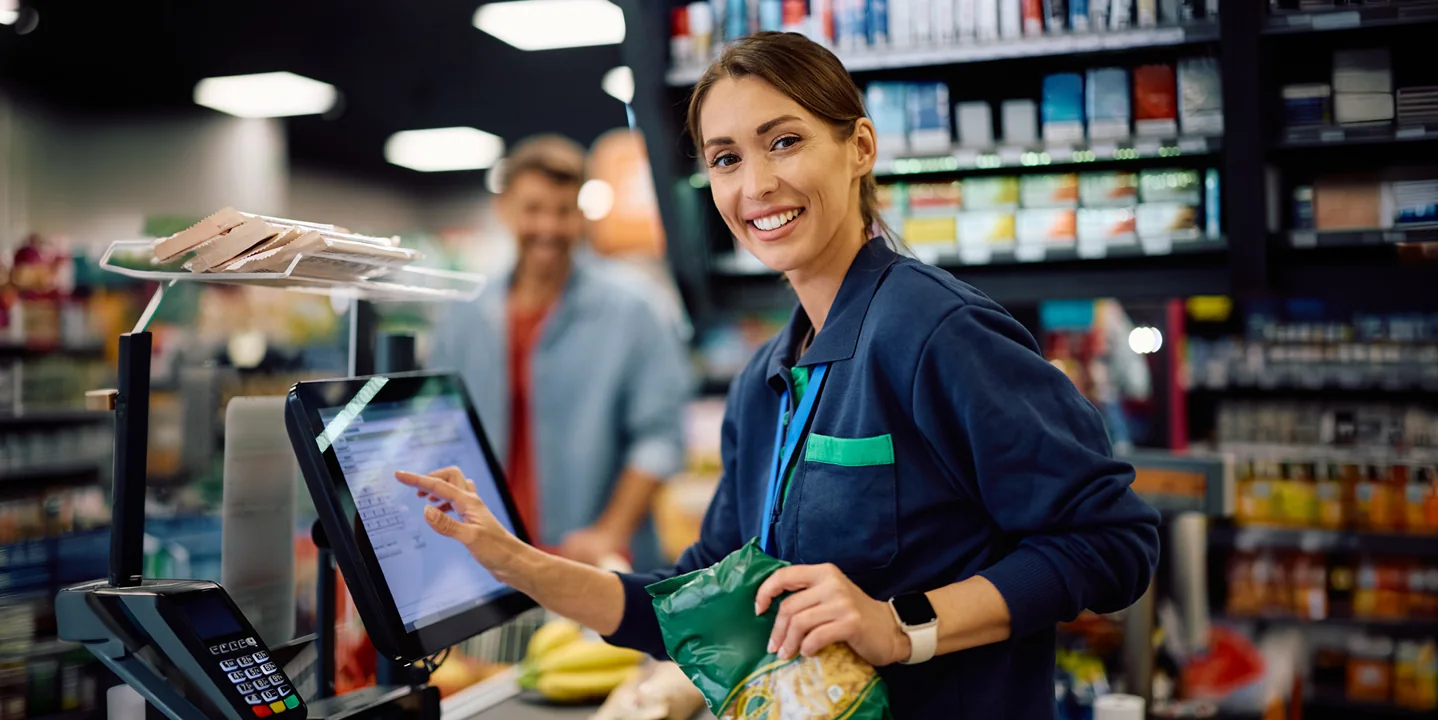
A modern point-of-sale system is more than a digital cash register. It is the operational backbone that connects billing, inventory, purchasing, pricing and customer data into one live view of the business. In practice, this is what grocery inventory management and supermarket billing software look like when they work together instead of operating as separate tools.
Real-Time Inventory Tracking
The moment an item is sold, returned or transferred, its stock level updates automatically. Managers no longer need to wait for an end-of-day spreadsheet to understand what is available.
Batch and Expiry Management
For perishables such as dairy, produce and bakery products, a good system tracks stock by batch and expiry date. First-expiry-first-out processes help staff move near-expiry items before they become total write-offs.
Barcode and PLU Management
Centralised barcode and price lookup management makes high-volume billing faster and more accurate. It also helps ensure that the price at the counter matches the approved price in the system.
Automated Purchasing and Vendor Management
Low-stock alerts based on actual sales velocity allow stores to reorder the right quantity at the right time instead of relying on memory or guesswork. Purchase histories also make supplier performance easier to evaluate.
Employee Permissions and Audit Trails
Every discount, return, cancellation and price override can be linked to a specific login. Manager-approval workflows add control without slowing down routine transactions.
GST-Ready Billing and Reporting
For Indian retailers, GST-ready billing is essential. A supermarket generating hundreds of invoices a day needs accurate tax calculation, compliant invoices and reliable reporting built into its daily workflow.
Actionable Business Reports
Useful reporting goes beyond answering “What sold today?” It should reveal which categories are weakening margins, which products are becoming dead stock, which suppliers are delaying replenishment and when additional billing counters are needed.
Technology maturity increasingly separates retail leaders from laggards. IHL Group’s retail technology findings report that profit winners are projected to earn approximately three times the profits of laggards in 2026. IHL also reports that AI-powered demand forecasting can reduce forecast error by 20–40%.
Five Profit Levers Supermarket POS Software Pulls
- Shrinkage control: Blind drawer counts, mandatory reason codes and approval workflows close small leaks before they compound.
- Inventory efficiency: Clear visibility into fast and slow movers reduces dead stock and lost sales from empty shelves.
- Speed at the counter: Faster billing shortens queues and reduces the risk of customers abandoning full baskets.
- Smarter pricing and promotions: Central control helps discounts deliver the intended margin result.
- Customer retention: Purchase histories support loyalty programmes and relevant offers that encourage repeat visits.
These levers reinforce one another. A supermarket that reduces shrinkage, cuts stockouts and speeds up billing frees both cash and staff time for further growth.
Two Supermarkets on the Same Street
Imagine two mid-sized supermarkets with similar daily footfall. One uses a basic billing machine and spreadsheets for stock. The other uses an integrated POS system.
At the first store, the owner discovers during a quarterly stock check that inventory value has disappeared through expiry, billing mistakes and unexplained discrepancies. Meanwhile, a best-selling cereal remains out of stock because nobody noticed the reorder point.
At the second store, the system flags low cereal stock before it runs out. Expiring dairy is moved to a promotional shelf before becoming a write-off. When a cashier attempts an unauthorised discount, manager approval is required.
Same street. Similar footfall. Very different bottom lines. The difference is not simply the software itself; it is the visibility and discipline the system makes possible.
How to Choose the Right Supermarket POS Software
Not every POS platform is built for supermarkets, where SKU counts can run into the thousands and perishables require tighter controls than general retail. When evaluating options, prioritise:
- Multi-store and multi-counter support so expansion does not require starting over.
- Batch and expiry management for perishable inventory.
- GST compliance built into billing and reporting.
- Cloud and mobile access for performance visibility beyond the store.
- Vendor and purchase-order automation for accurate replenishment.
- Barcode, weighing-scale and POS hardware integration for efficient checkout.
- Local onboarding and support so staff can use the system confidently.
Start with the store’s biggest pain point. Is it shrinkage, stockouts, billing speed, expiry loss or compliance? Choose a system that solves that problem first while providing room to scale.
The Bottom Line
India’s supermarket sector is expanding, but growth alone will not protect margins. The stores most likely to succeed will treat the billing counter as a source of business intelligence, not merely a place to collect payment.
A practical first step is to measure one number the business has not consistently tracked before: shrinkage percentage, stockout frequency, expiry write-offs or average billing time. That number will reveal where operational improvement is most urgent.
Elixir Retail 360 is built to close these gaps for Indian retailers. Its supermarket POS software combines real-time inventory, batch and expiry management, GST-ready billing, purchase workflows and reporting in one system. The result is simple: shrinkage, stockouts and slow billing stop being silent profit leaks and become measurable problems the business can act on.
Frequently Asked Questions
What is supermarket POS software?
Supermarket POS software connects checkout, billing, inventory, purchasing, pricing, customer data and reporting in one system. Every sale can update stock automatically and create a reliable operational record.
How does POS software improve supermarket profitability?
It helps reduce shrinkage, prevent stockouts, control discounts, minimise expiry losses, speed up billing and reveal which products or categories are weakening margins.
Which features should a supermarket POS system include?
Important features include GST-ready billing, barcode and weighing-scale integration, real-time inventory, batch and expiry tracking, multi-counter and multi-store support, purchase automation, employee permissions and detailed reports.
Can supermarket POS software manage multiple stores?
Yes. A suitable multi-store POS platform can centralise sales, stock, pricing, transfers and reporting across branches while preserving counter-level and employee-level controls.